Anthropic launched Claude Managed Agents today. Notion is one of the first companies using it. And the way it works inside Notion is worth paying attention to, because it previews what every productivity tool will look like within a year.
Claude Now Lives Inside Your Notion Workspace
Here is what happened. Anthropic released a new product called Claude Managed Agents, a suite of APIs that lets companies build and deploy AI agents on Anthropic's own infrastructure. The product is now in public beta on the Claude Platform.
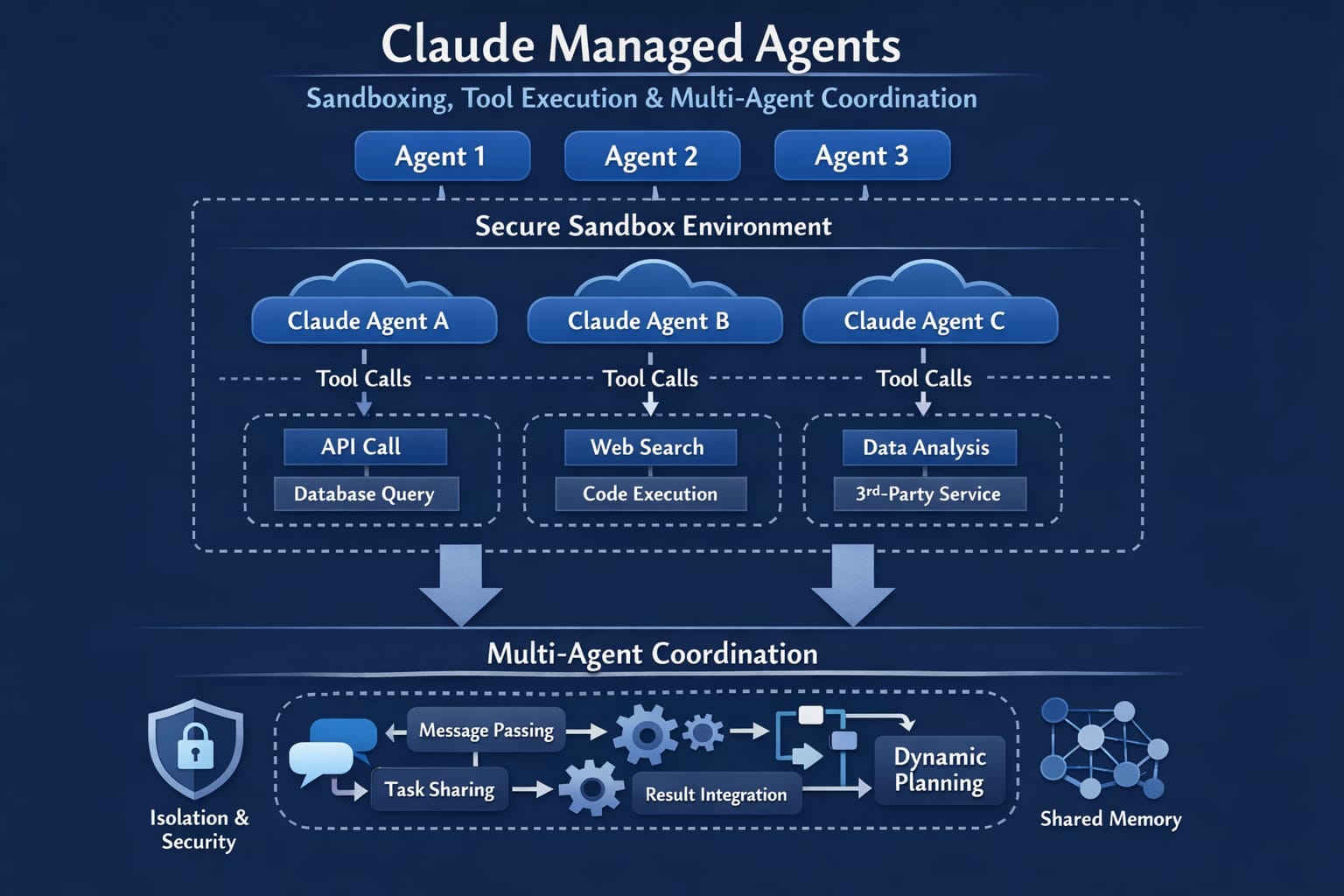
Think of it as agent-as-a-service. Companies define what the agent should do, which tools it can access, and what guardrails to follow. Anthropic handles everything else: the servers, the security sandbox, the error recovery, the session persistence. An agent can run for hours in the cloud without dropping its work, even if your connection goes down.
Introducing Claude Managed Agents: everything you need to build and deploy agents at scale.
— Claude (@claudeai) April 8, 2026
It pairs an agent harness tuned for performance with production infrastructure, so you can go from prototype to launch in days.
Now in public beta on the Claude Platform. pic.twitter.com/vHYfiC1G56
But the most compelling part of the announcement is not the infrastructure. It is what Notion built on top of it.
Eric Liu, a product manager at Notion, demonstrated how the integration works in a conversation published alongside the launch. Inside Notion, teams can now delegate entire task lists to Claude. The agent picks up items from a board, pulls context from connected documents like PRDs and specs, and works through them one by one. When it finishes, the team reviews and approves the output. All inside Notion.
Engineers use it to ship code. Knowledge workers use it to generate presentations and websites. Dozens of tasks can run in parallel. The feature is available now in private alpha through Notion Custom Agents, which already supports Claude, GPT, and Gemini as model options on Business and Enterprise plans.
Why Your Project Board Just Became a Delegation Tool
This matters because it changes what a project management tool actually is. Until now, tools like Notion, Asana, and Monday were places where humans organized work for other humans. You created a task, assigned it to a colleague, and waited.
Now the colleague can be an AI agent.
Angela Jiang, head of product for the Claude Platform at Anthropic, framed the challenge this way: the hardest part of deploying AI agents is no longer model quality. It is orchestration, permissions, memory, and long-running execution. Managed Agents is designed to solve exactly that layer.

And Notion is not the only company moving fast. Rakuten deployed specialist agents across product, sales, marketing, finance, and HR, each one shipped within a week. These agents plug into Slack and Teams, accept task assignments, and return deliverables like spreadsheets and slide decks. Sentry paired its existing debugging tool with a Claude-powered agent that writes patches and opens pull requests. A flagged bug now flows directly to a reviewable fix.
For a marketing manager reading this: imagine assigning your weekly reporting task to an agent that pulls data from connected sources, formats the report, and drops it into your team's database. Every Monday morning. Without a prompt.
For a project manager: imagine your sprint board items being triaged, researched, and drafted before your standup even starts.
That is the direction Notion is heading. And it is not alone. Asana built AI Teammates using the same infrastructure, and Atlassian is integrating managed agents directly into Jira workflows.


The Real Shift: From Chatbot to Coworker
The pricing model tells you where Anthropic thinks this is going. Managed Agents charges standard token rates plus $0.08 per session-hour of active runtime. That is not chatbot pricing. That is employee-hour pricing. Anthropic is positioning Claude not as a tool you query, but as a worker you deploy.
[IMAGE: Screenshot of Claude Console showing session tracing and agent activity monitoring | Anthropic blog post or documentation]
Anthropic's annualized recurring revenue recently passed $30 billion, according to reporting this week. The company has raised over $7 billion in total funding. Managed Agents is a direct play for sticky, long-term enterprise relationships. Once a company's workflows run on this infrastructure, switching costs go up fast.
The competitive landscape is getting crowded. Salesforce has AgentForce. Microsoft has Copilot Studio. Google is building agent infrastructure into Vertex AI. But Anthropic is betting that reliability and safety matter more than ecosystem size when companies are handing real work to autonomous systems.
Internal testing showed that Managed Agents improved task success rates by up to 10 percentage points compared to standard prompting, with the biggest gains on the hardest problems. A research preview feature lets developers define success criteria while Claude iterates toward meeting them, useful for tasks where "good enough" requires judgment.
The question for every professional is no longer whether AI can help with your work. It is whether your company will deploy AI agents that work alongside you, picking up tasks from the same board you use every morning. Notion just answered that question for its users. The rest of the industry is about to follow.