Three months ago, Anthropic launched Cowork as an experiment. Today, it is generally available on every paid Claude plan, and it comes with the kind of enterprise controls that signal something bigger: Anthropic wants Claude sitting in every department, not just engineering.
From Research Preview to Enterprise-Ready in 90 Days
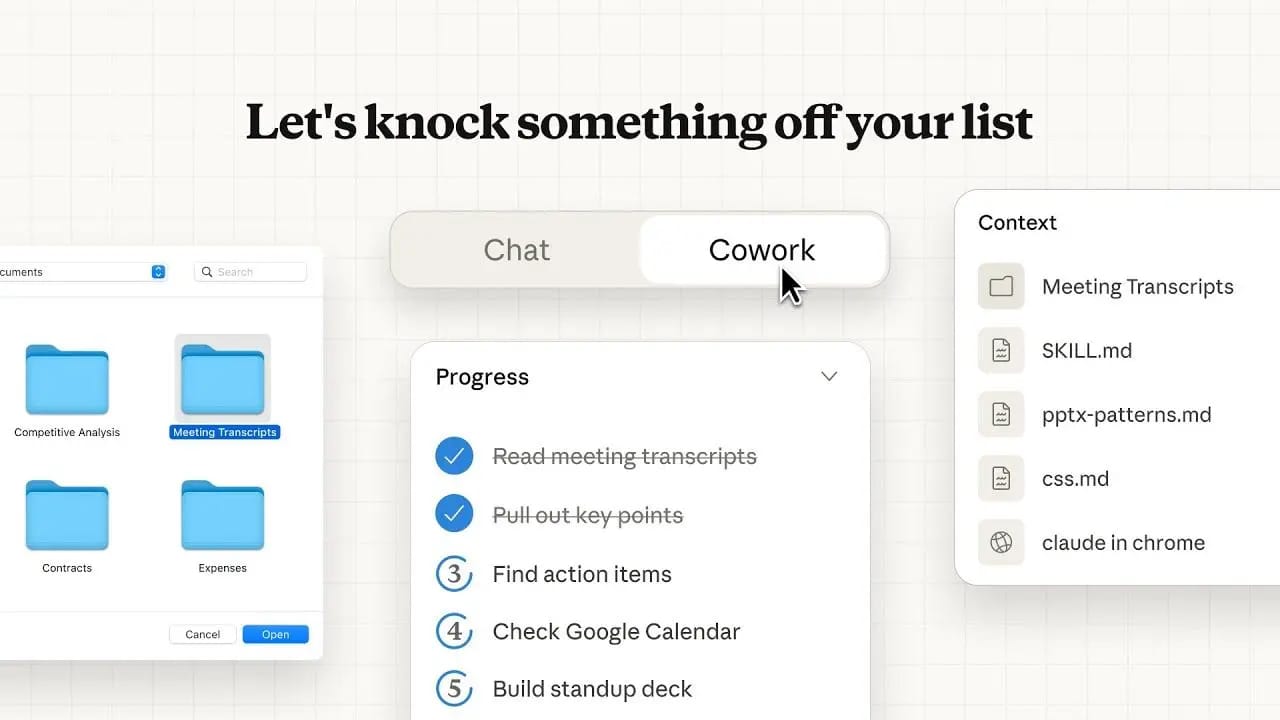
Claude Cowork launched in January as a research preview, essentially a version of Claude Code designed for people who do not write code. The concept was simple: describe a task, hand Claude a folder, and let it work. Organize files, draft reports, compile research, build spreadsheets. The kind of work that fills your afternoon but does not require your brain.
Today's announcement drops the "research preview" label and adds six enterprise features that IT departments have been waiting for. Role-based access controls let admins organize users into groups through SCIM integration with existing identity providers, then define exactly which Claude capabilities each group can access. Group spend limits give finance teams a way to control costs at the organizational level. Usage analytics provide visibility into how teams are actually using the tool. And expanded OpenTelemetry support gives engineering and security teams the observability layer they need to monitor agent activity.

Two additional features round out the update. A Zoom MCP connector brings meeting summaries, action items, and transcripts directly into Cowork workflows, turning meeting output into automated follow-up tasks. And per-tool connector controls let admins get granular, enabling read access to a data source while blocking write operations, for example, all managed from a central admin console.
Claude Cowork is now generally available to all paid plans.
— Claude (@claudeai) April 9, 2026
For Enterprise, we are adding role-based access controls, group spend limits, usage analytics, and expanded OpenTelemetry to give admins what they need to deploy it across the org. pic.twitter.com/JHG1MYDYgD
Why This Matters If You Are Not in IT
The enterprise controls are the headline, but the real story is what Anthropic shared about who is actually using Cowork. According to the company, non-engineering teams now account for the majority of Cowork usage within early enterprise adopters. Operations, marketing, finance, and legal teams are the primary users.
That is a significant shift. AI productivity tools have spent years being developer-first products that everyone else watches from the sidelines. Cowork flips that dynamic. The people generating expense reports, compiling board decks, writing performance reviews, and organizing vendor evaluations are now the core audience.
The early adopter stories reinforce this pattern. Zapier connected Cowork to their internal database, Slack, and Jira to surface engineering bottlenecks, then generated dashboards and prioritized roadmaps that product and design ops teams replicated for their own workflows. Jamf compressed a seven-part performance review process into a 45-minute guided self-evaluation, then extended the same approach to vendor reviews and incident response. Venture firm Airtree built board prep workflows that pull from portfolio company Drive folders, Slack updates, and competitor news automatically.
The common thread is delegation of coordination overhead. Teams are not asking Claude to make decisions. They are asking it to assemble the information they need to make decisions faster.
The Bigger Picture: AI Agents Just Became a Line Item
Today's announcement also came alongside a separate launch: Claude Managed Agents, a new public beta offering composable APIs for building and deploying cloud-hosted agents at scale. Companies like Notion, Asana, and Sentry have already built solutions using the platform.
Together, these two announcements paint a clear picture of where Anthropic is heading. Cowork handles the desktop, local-file, and knowledge-work side. Managed Agents handles the cloud, API, and developer side. Both share the same agent loop and SDK. Both are now positioned as production-grade enterprise products, not experiments.


For professionals, the practical takeaway is straightforward. If your company uses a paid Claude plan, Cowork is now available in the desktop app on macOS and Windows. Pro subscribers get access at $20 per month. Max plans at $100 or $200 per month offer significantly higher usage limits, which matters because agentic tasks consume more capacity than regular chat.
The pricing model on Enterprise is different: seats are billed annually with all usage (chat, Claude Code, and Cowork) charged separately at API rates. Admins can set spend limits at both the organization and individual user levels.
The gap between "AI chatbot" and "AI coworker" just got a lot smaller. Three months ago, Cowork was a research preview for early adopters. Today, it has admin controls, spend limits, and a Zoom connector. That is not an experiment anymore. That is infrastructure.