
If you have used ChatGPT, Claude, or any AI chatbot, you already know the basics. You type a question, the AI answers. But what if the AI could do more than answer? What if it could actually do things for you? That is exactly what Anthropic just made dramatically easier.
First, What Is an AI Agent?
Before we get into today's news, let's clear up a term you are going to hear a lot more in the coming months: AI agent.
A regular AI chatbot is like a very knowledgeable colleague sitting across from you. You ask a question, they give you an answer. But they never get up from their chair. They never open a spreadsheet, send an email, or check a website on their own. You do all the work. They just talk.
An AI agent is different. Think of it as an AI that can actually get up and do things. You give it a task, and it figures out the steps, uses the right tools, and completes the work. It can read files, write documents, search the internet, run code, analyze data, and even operate other software. All without you guiding every single step.
Here is a simple example. You tell a chatbot: "What are the key points in this 50-page contract?" It reads the text you paste and gives you a summary. Helpful, but limited. You tell an AI agent: "Review this contract, flag any unusual clauses, compare the terms with our standard template, and email me a summary by 5 PM." The agent opens the files, does the comparison, writes the report, and sends the email. Multiple steps, multiple tools, minimal hand-holding.
That is the difference. A chatbot answers. An agent acts.

Now, the problem. Building an AI agent that works in a demo is relatively easy. Building one that works reliably inside a real company, day after day, handling real data and real tasks? That has been incredibly hard. Until today.
The Problem Nobody Solved (Until Now)
There is a dirty secret in the AI industry. Most companies that experiment with AI agents never get them past the testing phase. Not because the AI is not smart enough. Because making it run reliably in a real business requires an enormous amount of behind-the-scenes engineering.
Think of it like this. Imagine you hired a brilliant new employee. They can write, analyze data, search the internet, manage files, and follow complex instructions. But before they can start working, you need to build their entire office from scratch. The desk, the computer, the network, the security system, the phone lines. Every single piece of infrastructure, from zero.
That is what building AI agents has looked like. The AI itself works great. But the plumbing around it? That takes months of engineering work and a specialized team most companies simply do not have.
The numbers tell the story. According to recent industry data, over 70% of companies trying to use AI agents say their biggest problem is not the AI. It is getting the agent to actually run in production. The technology works. The deployment does not.
What Anthropic Just Launched
Today, Anthropic announced Claude Managed Agents. The idea is simple, even if the technology behind it is not.
You tell Anthropic what you want your AI agent to do. Anthropic builds the office, sets up the computer, connects the network, and keeps everything running. You just define the job.
In practical terms, here is what changes. Before today, if a company wanted an AI agent that could process customer support emails, it needed to set up servers, build error-handling systems, configure security, manage memory, and write the code that ties everything together. A project that could take a development team weeks or months.
With Managed Agents, that same company defines the task, picks the tools the agent needs, and launches it in days. Anthropic handles the computing power, the security, the file storage, the error recovery, and the scaling.
Introducing Claude Managed Agents: everything you need to build and deploy agents at scale.
— Claude (@claudeai) April 8, 2026
It pairs an agent harness tuned for performance with production infrastructure, so you can go from prototype to launch in days.
Now in public beta on the Claude Platform. pic.twitter.com/vHYfiC1G56
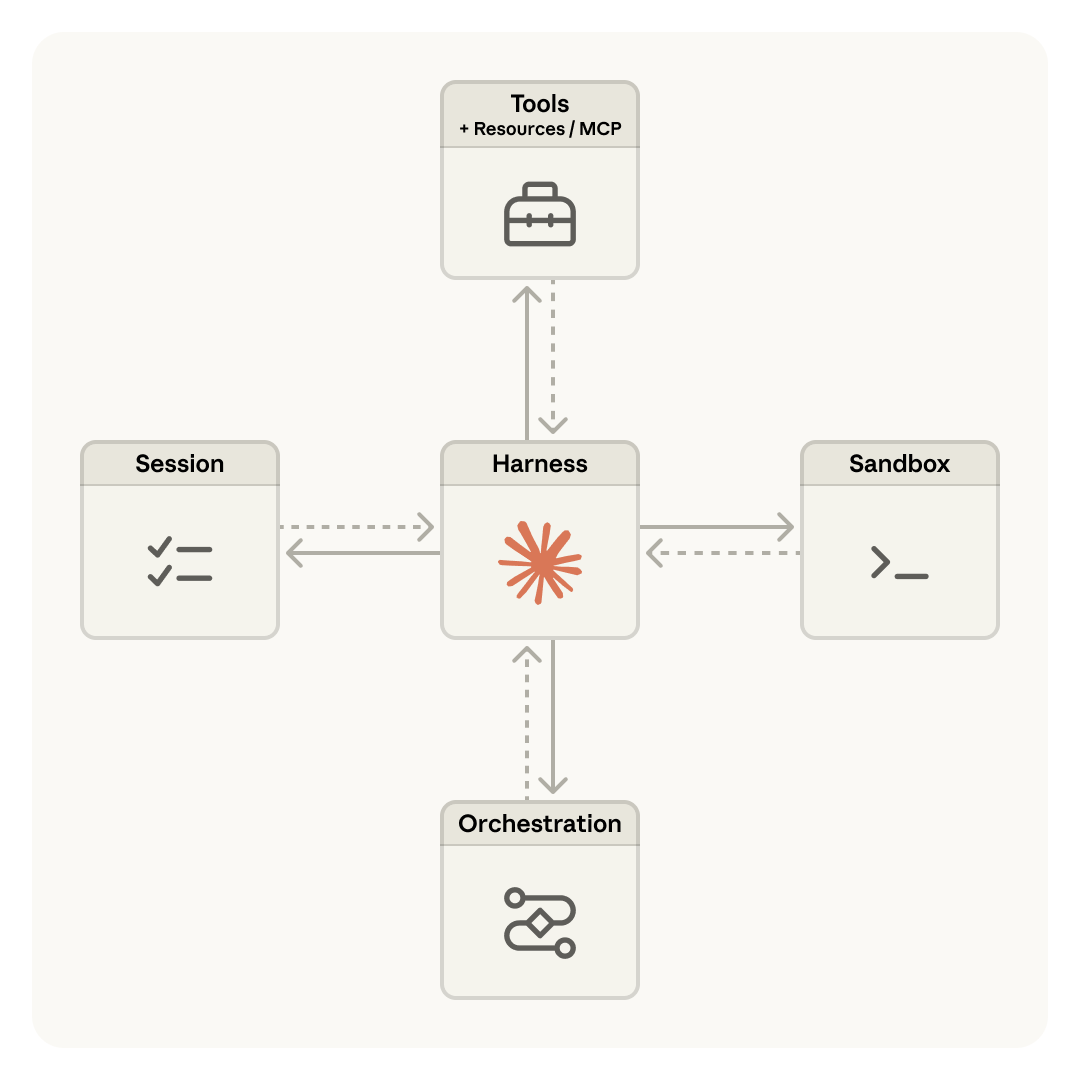
The product works around four simple ideas. An Agent is the AI with its instructions and tools (think: the employee's job description). An Environment is the virtual workspace where it runs (the office). A Session is one specific task the agent is working on (a project). And Events are the messages going back and forth between your application and the agent (the conversation).
The out-of-the-box toolset is already broad. Agents can run commands, read and write files, search the web, retrieve content from websites, and connect to external tools through something called MCP servers. That covers most of what business agents actually need.
The service launched today in public beta, meaning any developer with a Claude API account can start using it right now. No waitlist, no special invitation.
Why Should You Care If You Are Not a Developer?
You might be thinking: "I do not write code. Why does this matter to me?"
Because every company you interact with, every service you use, is about to get better at automating complex tasks. Not because AI suddenly got smarter. But because the barrier to deploying AI agents just dropped from months to days.
Here is what that looks like in the real world. Your bank could deploy an AI agent that monitors transactions and flags unusual activity, not in six months after a big IT project, but in a matter of days. A law firm could set up an agent that reviews contracts overnight and highlights risks before the partner even arrives at the office. A marketing team could launch an agent that analyzes campaign results across ten platforms and delivers a summary every morning before the team meeting.
None of this is new in theory. What is new is that it just became dramatically easier to do in practice.

This also matters because the tools you use at work are about to change. When AI agents become easy to deploy, companies will start replacing manual processes with automated ones. Not to eliminate jobs, but to handle the repetitive, time-consuming tasks that eat up your day. The report nobody wants to compile. The data nobody wants to consolidate. The inbox nobody can keep up with.

The Bigger Picture
Anthropic is not doing this in a vacuum. This launch is the culmination of months of aggressive moves toward becoming a full enterprise AI platform, not just a company that sells a smart chatbot.
In January, they launched Cowork for persistent agent workflows. In February, they rolled out enterprise plugins for finance, legal, and HR departments. In March, they shipped computer use (Claude literally controlling a computer screen to complete tasks) and opened the Agent Skills standard so agents could learn repeatable workflows.
Each of those was a puzzle piece. Managed Agents is the picture on the box.
The move also puts Anthropic in direct competition with Microsoft, Google, and Amazon, all of which offer their own managed agent infrastructure tied to their cloud platforms. The difference? Anthropic builds both the AI and the infrastructure. Same company, one integrated system. That means tighter optimization and, potentially, better performance at lower cost.
Three features already in research preview signal where this is headed. Outcomes let you define what success looks like for an agent task. Multiagent coordination lets multiple agents work together on the same project, like a team. And Memory gives agents the ability to remember what happened in previous sessions, so they get better over time.
If those features mature, we are not just talking about AI that completes tasks. We are talking about AI systems that learn, coordinate, and improve the more you use them.

The race in AI has quietly shifted. It is no longer just about who has the smartest model. It is about who makes AI the easiest to actually use in the real world. Anthropic just made its strongest argument yet.